




Nippon Steel-US Steel Partnership Activates Federal ‘Golden Share’ Clause: A Global Market Analysis
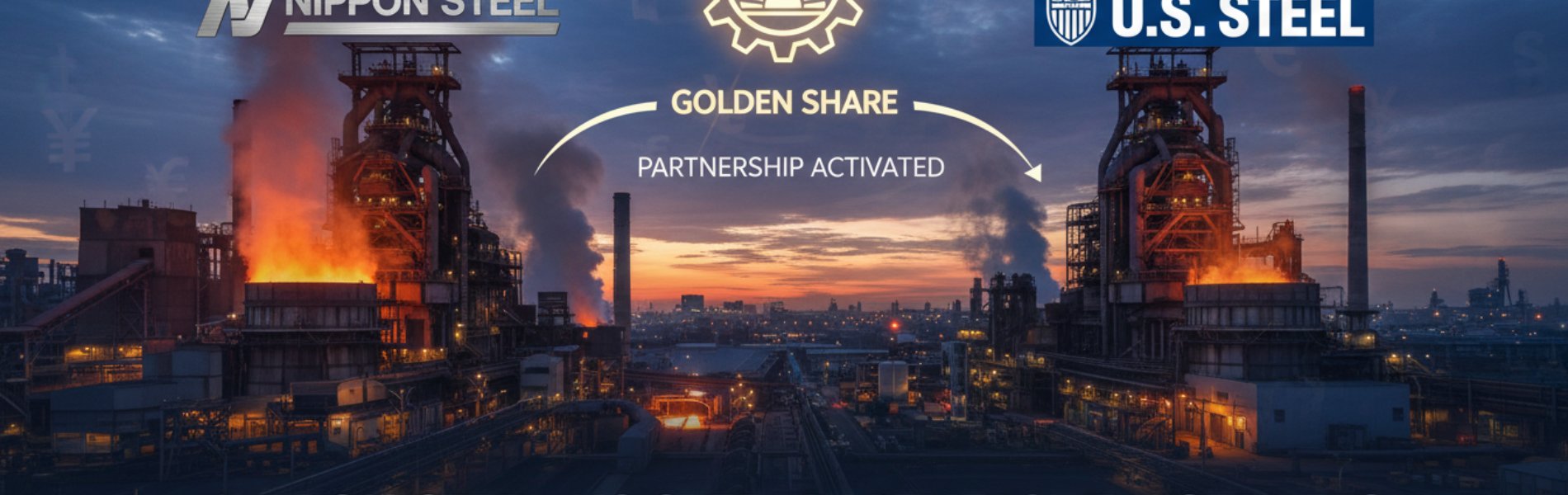
The landscape of the global steel industry is undergoing a seismic shift, marked by the high-profile acquisition bid of U.S. Steel by Japan's Nippon Steel. This proposed merger, valued at approximately $14.9 billion, has transcended typical corporate consolidation to become a matter of high-stakes geopolitics and national security. At the heart of this controversy is the effective activation of a federal 'Golden Share' clause—a metaphorical and regulatory mechanism by which the United States government exerts sovereign control over critical industrial assets. For stakeholders at SaudiSteelWork and across the MENA region, understanding the nuances of this partnership is crucial for navigating future supply chains and commodity pricing.
The Mechanics of the Historic Acquisition
The bid by Nippon Steel creates a transatlantic giant capable of producing over 86 million tons of crude steel annually. The strategic intent is clear: to counter the dominance of the Chinese steel industry and leverage American manufacturing capabilities for the electric vehicle (EV) sector. However, the transaction is not merely financial. It involves complex layers of intellectual property transfer, blast furnace technology integration, and access to the lucrative American automotive market.
By acquiring an iconic American industrial symbol, Nippon Steel aims to secure a footprint in a market shielded by protectionist tariffs like Section 232. Yet, this ambition has triggered the 'Golden Share' phenomenon, where the U.S. government, through the Committee on Foreign Investment in the United States (CFIUS), steps in as the ultimate arbiter, treating the asset as public infrastructure rather than private property.
Decoding the Federal 'Golden Share' Clause
While the United States does not typically hold literal 'golden shares' (equity with veto power) in private companies like U.S. Steel, the current regulatory environment functions as a de facto equivalent. The federal intervention draws upon the Defense Production Act and broad national security interpretations to scrutinize the deal. This 'Golden Share' clause is activated when foreign ownership is perceived to threaten critical infrastructure or defense supply chains.
For the metallurgy sector, this sets a profound precedent. It signals that Western governments are moving toward a model of 'friend-shoring' but retain a veto right even against close allies like Japan if domestic labor unions—such as the United Steelworkers (USW)—and political interests are not aligned. This regulatory friction creates volatility in global steel prices, affecting downstream consumers worldwide.
Impact on Global Supply Chains and Pricing
The uncertainty surrounding the deal has immediate implications for the raw materials market. If the merger proceeds, we may see a consolidation of iron ore and coking coal procurement strategies, potentially tightening supply for other global players. Conversely, if the federal 'Golden Share' vetoes the deal, U.S. Steel may be forced to fragment or seek alternative, likely domestic, buyers like Cleveland-Cliffs, which would drastically alter the competitive landscape of flat-rolled steel in North America.
For international observers, particularly in Saudi Arabia, the lesson is centered on resource nationalism. The barriers being erected around American steel assets suggest a future where cross-border industrial mergers become increasingly difficult, requiring higher premiums and complex political maneuvering.
Implications for SaudiSteelWork and Vision 2030
Saudi Arabia’s Vision 2030 relies heavily on a robust supply of high-grade steel for giga-projects like NEOM, The Line, and the Red Sea Project. The Nippon-U.S. Steel saga is relevant to SaudiSteelWork for several reasons:
- Technology Transfer: The deal highlights the value of electrical steel used in EV motors. As Saudi Arabia builds its own EV hub with Ceer Motors and Lucid, access to such specialized steel grades is paramount.
- Green Steel Transition: Both Nippon and U.S. Steel are investing heavily in decarbonization. Their combined R&D budget could accelerate the development of hydrogen-based steelmaking, a technology Saudi Arabia is uniquely positioned to lead given its hydrogen production potential.
- Market Stability: Consolidation among top-tier producers often leads to price stabilization but can also reduce bargaining power for importers. Saudi contractors must diversify their steel procurement strategies to mitigate risks associated with Western protectionism.
The Role of Labor and Political Capital
The opposition from the United Steelworkers union underscores the 'Golden Share' concept's reliance on political capital. In the U.S., labor unions hold significant sway over trade policy. This contrasts with the Gulf Cooperation Council (GCC) model, but the outcome remains the same: industrial strategy is inseparable from state policy. The federal government’s hesitation to approve the deal, despite Japan being a military ally, proves that economic security is now viewed through the same lens as military security.
Strategic Forecast: The Era of Neo-Protectionism
As we analyze the trajectory of this partnership, it becomes evident that the era of unfettered globalization in heavy industry is receding. We are entering a phase of Neo-Protectionism where the 'Golden Share'—whether literal or regulatory—is the ultimate safeguard. For SaudiSteelWork, this means that future partnerships with international entities will likely require rigorous sovereignty impact assessments.
The steel manufacturing ecosystem is tightening. The separation between commercial interests and national strategy has blurred. Whether the deal closes or collapses, the activation of the federal review process has already changed the rules of engagement. Investors and industrial leaders must now account for the 'Golden Share' risk premium in every major cross-border acquisition.
In conclusion, the Nippon Steel-U.S. Steel partnership is a bellwether for the future of the industrial economy. It highlights the tension between capital efficiency and national sovereignty. For SaudiSteelWork, staying ahead of these trends is not just about monitoring prices, but understanding the geopolitical currents that drive the availability of the world’s most critical construction material.