




China Implements Mandatory Steel Export Licensing Following Record 2025 Shipments
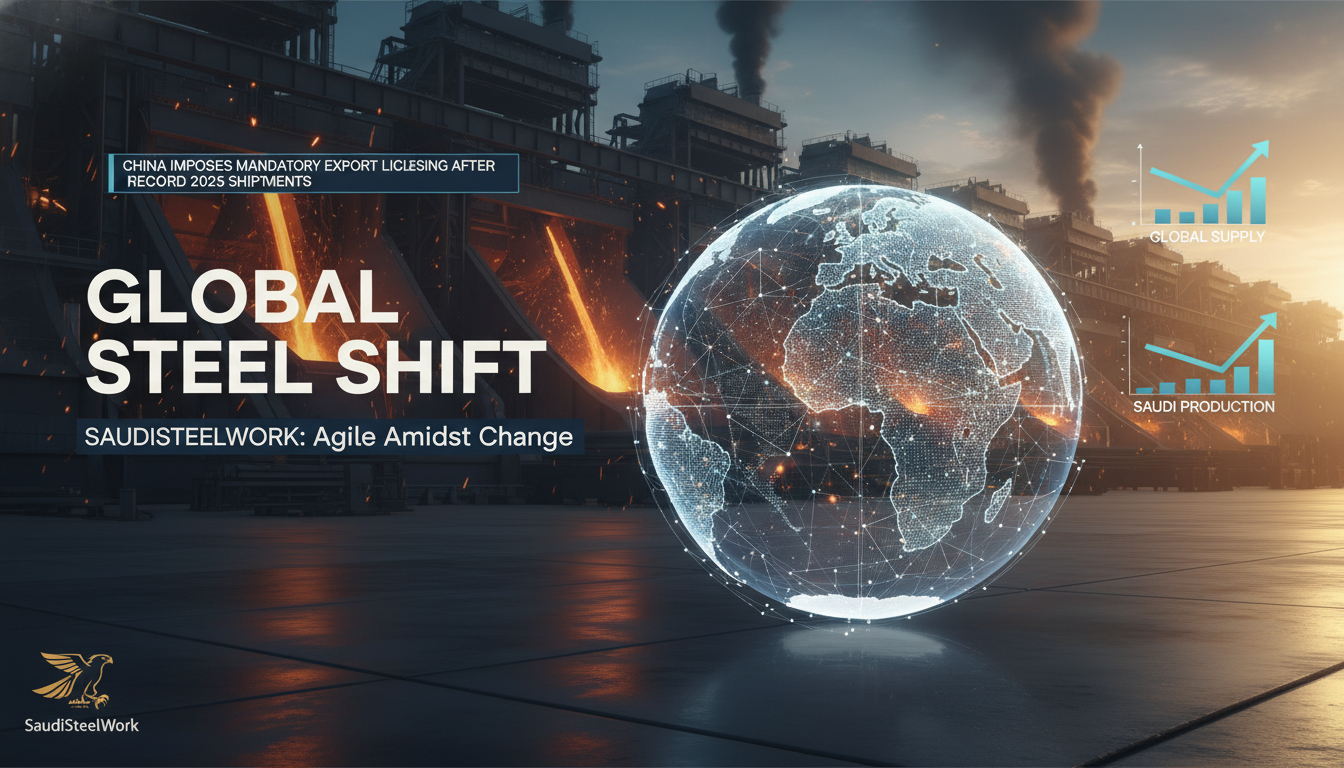
The global steel industry is bracing for a seismic shift. In a decisive move to curb the “blind expansion” of low-value exports and mitigate rising trade frictions, Beijing has announced the implementation of a mandatory steel export licensing system. Set to take effect in early 2026, this regulatory overhaul follows a year of historic volatility, where Chinese steel exports hit record monthly highs throughout 2025. For industry stakeholders and partners of SaudiSteelWork, understanding the mechanics and implications of this policy is no longer optional—it is a strategic necessity.
The Catalyst: 2025’s Record-Breaking Export Surge
To understand the future, we must analyze the immediate past. The year 2025 will be remembered as the apex of Chinese steel dominance in volume terms. Driven by sluggish domestic property demand and a persistent manufacturing surplus, Chinese mills flooded the global market. Exports surged past previous records, triggering a wave of global protectionist responses from the European Union, South America, and Southeast Asia.
Data from the General Administration of Customs indicates that Chinese steel exports frequently exceeded 10 million tonnes per month in 2025. This influx depressed global steel prices, squeezing margins for producers worldwide and leading to a proliferation of anti-dumping investigations. The sheer volume of material entering international ports forced Beijing’s hand. The government’s priority has shifted from maintaining production volume to ensuring high-quality development and reducing trade hostilities.
Decoding the New Licensing Mechanism
The new framework, jointly announced by the Ministry of Commerce (MOFCOM) and the General Administration of Customs, marks a departure from the relatively unrestricted export environment of the past decade. Starting in 2026, steel products—including hot-rolled coils, rebar, and specialty alloys—will require specific export licenses.
The “Dual-Track” Verification System
This is not merely a paperwork hurdle; it is a volume control mechanism. The system introduces a “dual-track” verification process. Exporters must now provide detailed documentation proving that their shipments comply with new pricing floors and destination-specific quotas. This move effectively ends the era of aggressive price undercutting that defined the 2025 market.
Furthermore, the licensing regime is expected to tighten controls on “processing trade” versus “general trade.” By scrutinizing the end-use and destination of exports, Beijing aims to eliminate tax evasion strategies and ensure that exports contribute to the country’s strategic value chain rather than merely offloading excess capacity.
The Global Ripple Effect: Protectionism and Pricing
The introduction of export licensing is a direct response to the escalating trade war risks. In 2025 alone, over a dozen nations initiated safeguard measures against Chinese steel. By self-regulating through licensing, China attempts to preempt further punitive tariffs.
For the global market, the immediate impact will be a contraction in supply availability. As Chinese export volumes stabilize or decrease, global steel prices are projected to harden. The days of rock-bottom pricing driven by Chinese oversupply are likely ending. Buyers who relied solely on spot-market purchases from Chinese traders may face significant supply disruptions as non-compliant exporters are purged from the market.
Impact on the EU and Carbon Border Mechanisms
This policy also aligns with global decarbonization trends. With the EU Carbon Border Adjustment Mechanism (CBAM) tightening, China is incentivized to export higher-value, lower-carbon steel. The licensing system provides a regulatory filter to discourage the export of highly polluting, low-margin products, thereby improving the overall carbon footprint of Chinese exports.
Implications for the Middle East and Saudi Construction
For the Middle East, and specifically the booming construction sector in Saudi Arabia, the implications are profound. The Kingdom’s Giga-projects require a consistent, reliable flow of high-quality steel. The restriction of Chinese supply could initially create volatility in local pricing.
However, this transition presents a distinct advantage for established players like SaudiSteelWork. As the market shifts away from opportunistic, low-cost trading, the value of secure, long-term supply agreements increases. The licensing system favors large, state-owned Chinese enterprises and established international partners over small, fly-by-night trading houses.
SaudiSteelWork anticipates that while spot prices may rise, the quality assurance and reliability of shipments will improve. The licensing mandate ensures that the material arriving at Saudi ports meets rigorous standards, reducing the risk of receiving substandard steel that often accompanied the unregulated surges of 2025.
Strategic Adaptation for Steel Importers
In this new regulatory environment, procurement strategies must evolve. Relying on transactional relationships with unverified Chinese mills is now a high-risk strategy. Importers must prioritize:
- Supply Chain Transparency: Verifying that suppliers hold valid export licenses under the new 2026 regime.
- Diversification: While China remains a powerhouse, balancing procurement with domestic production and other international sources is vital.
- Contract Rigidity: Locking in pricing and volume with reputable partners like SaudiSteelWork to buffer against regulatory-induced volatility.
Conclusion: A New Era of Regulated Trade
The implementation of mandatory steel export licensing by Beijing is a watershed moment. It signifies the end of the “volume-at-all-costs” era and the beginning of a managed, quality-focused export strategy. While the transition in 2026 will undoubtedly cause friction as the market digests the new rules, the long-term result will be a more stable, albeit more expensive, global steel market.
For SaudiSteelWork, this development underscores the importance of our mission: delivering resilience and quality in a volatile world. As global trade barriers rise and regulations tighten, we remain committed to navigating these complexities to keep the region’s infrastructure projects on track.