



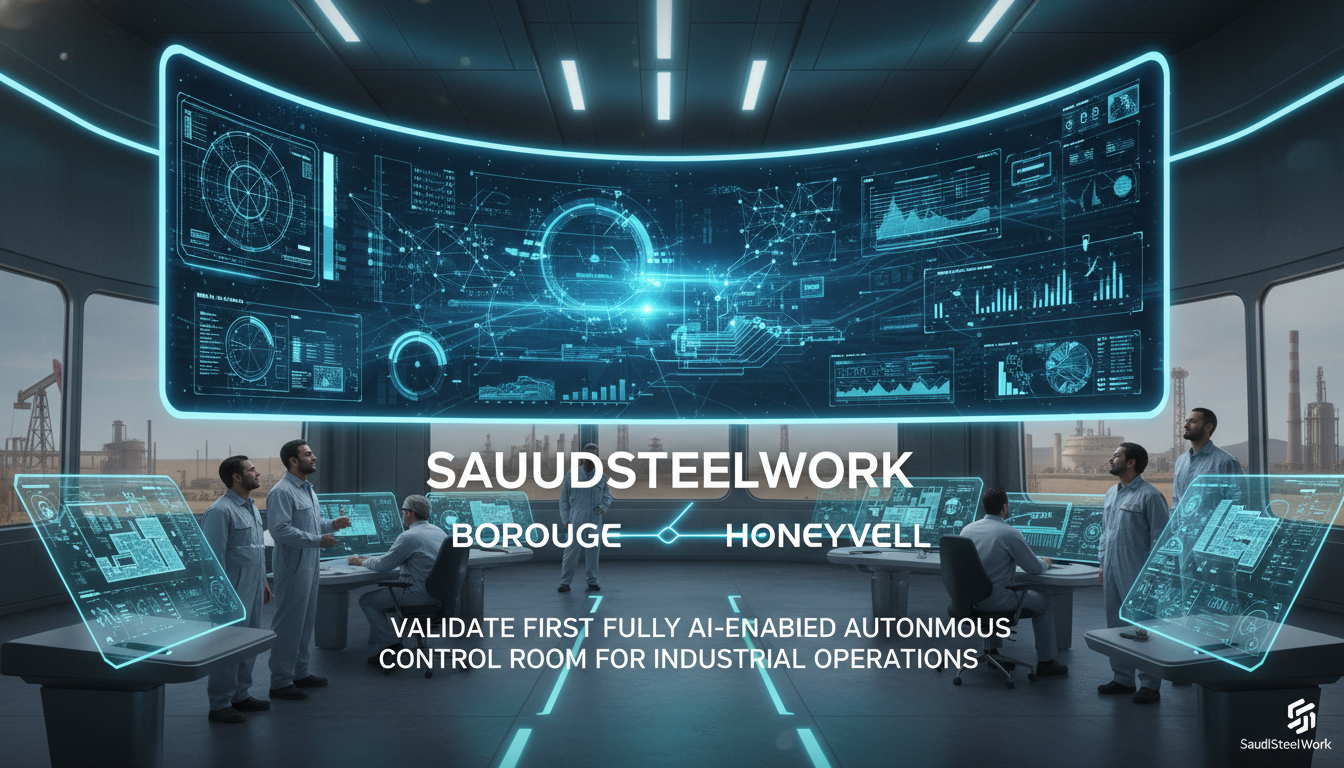
Revolutionizing Manufacturing: Borouge and Honeywell Unveil the First AI-Enabled Autonomous Control Room
In a historic leap for the global energy and manufacturing sectors, Borouge, a leading petrochemical company providing innovative and differentiated polyolefin solutions, and Honeywell, a global technology leader, have successfully validated the world’s first fully AI-enabled autonomous control room. This groundbreaking achievement marks a significant milestone in the journey toward Industry 4.0, setting a new precedent for efficiency, sustainability, and digital transformation in industrial operations.
For industry stakeholders, including those in the steel and heavy manufacturing sectors represented by SaudiSteelWork, this development signals a paradigm shift. The transition from automated systems to fully autonomous operations is no longer a futuristic concept but a tangible reality that promises to redefine how plants operate, optimize energy consumption, and manage complex processes.
The Collaboration: Merging Petrochemical Expertise with Advanced Tech
The partnership between Borouge and Honeywell represents a strategic alignment of industrial might and technological innovation. Validated at Borouge’s polyolefins plant in Al Ruwais Industrial City, United Arab Emirates, this initiative utilizes Honeywell’s Experion® Cognitive Autonomous Operations platform. This system is designed to leverage Artificial Intelligence (AI) and Machine Learning (ML) to manage operations with minimal human intervention.
The successful validation demonstrates the capability of AI to function as a digital operator, analyzing real-time data to make split-second decisions that optimize plant performance. This collaboration highlights the GCC region’s growing role as a hub for industrial innovation and digital excellence.
Understanding the Technology: Experion® Cognitive Autonomous Operations
At the core of this breakthrough is the Experion® Cognitive Autonomous Operations solution. Unlike traditional control systems that rely heavily on human operators to interpret data and adjust parameters, this AI-driven system continuously monitors the plant’s status. It utilizes a digital twin—a virtual replica of the physical plant—to simulate scenarios and predict outcomes before implementing changes in the real world.
Key Features of the System:
The system excels in several critical areas:
- Predictive Analysis: It anticipates potential issues before they cause downtime.
- Real-time Optimization: It adjusts process variables dynamically to ensure maximum output and quality.
- Energy Efficiency: It actively seeks ways to reduce energy consumption, directly contributing to sustainability goals.
For industries like steel manufacturing, where process stability and energy costs are paramount, the implications of this technology are profound. It suggests a future where autonomous manufacturing becomes the standard for maintaining competitiveness.
Driving Sustainability and Reducing Carbon Footprint
One of the most compelling aspects of the Borouge and Honeywell validation is its impact on environmental sustainability. The AI-enabled control room is not just about operational speed; it is about precision. By optimizing processes to their theoretical limits, the system significantly reduces energy waste and lowers the plant’s carbon footprint.
In the context of the Saudi Green Initiative and global decarbonization targets, this technology offers a practical roadmap for heavy industries. Borouge has reported that the autonomous system aids in adhering to strict environmental regulations while maintaining high production yields. This dual benefit of economic and environmental efficiency is the “holy grail” for modern industrial operations.
The Role of AI in the Future of Industrial Workforce
A common concern regarding autonomous operations is the displacement of human workers. However, Honeywell and Borouge emphasize that this technology is designed to augment human capabilities, not replace them. By automating routine and complex control tasks, the AI allows human operators to focus on higher-level strategic decision-making and maintenance planning.
This shift transforms the role of the operator from a reactive monitor to a proactive manager of digital assets. For companies like SaudiSteelWork, preparing the workforce for this digital transition is as crucial as investing in the hardware itself. Upskilling employees to work alongside AI systems will be a defining characteristic of successful industrial firms in the coming decade.
Implications for the Saudi Industrial Sector
While this validation occurred in the UAE, the ripples are felt strongly across the border in Saudi Arabia. As the Kingdom pushes forward with Vision 2030, aiming to diversify its economy and lead in high-tech manufacturing, the adoption of autonomous control rooms becomes highly relevant. The steel, oil, gas, and petrochemical sectors in Saudi Arabia are prime candidates for this technology.
Why Saudi Industries Should Pay Attention:
Integrating AI-driven autonomy offers several competitive advantages:
- Enhanced Safety: Reducing human exposure to hazardous environments by managing them remotely and autonomously.
- Operational Resilience: AI systems do not suffer from fatigue and can operate at peak performance 24/7.
- Data-Driven Insights: The massive amount of data processed provides actionable insights for long-term asset management.
Conclusion: A New Era of Autonomous Operations
The successful validation of the first fully AI-enabled autonomous control room by Borouge and Honeywell is more than a technical achievement; it is a vision of the future realized. It proves that the convergence of operational technology (OT) and information technology (IT) can unlock unprecedented value in the industrial sector.
For SaudiSteelWork and the broader manufacturing community, this serves as a clarion call to embrace digital transformation. As the technology matures, we can expect to see similar autonomous solutions deployed across steel mills, refineries, and manufacturing plants throughout the region, driving a cleaner, safer, and more efficient industrial future.