







EU CBAM Enforcement Era Begins: Erasing Traditional Steel Import Price Advantage
The global landscape of international trade and industrial manufacturing is undergoing a seismic shift. For decades, the economics of the steel industry were dictated largely by production costs, labor rates, and raw material accessibility. This dynamic allowed nations with looser environmental regulations to export steel at significantly lower prices, undercutting cleaner producers. However, the dawn of the EU Carbon Border Adjustment Mechanism (CBAM) marks the end of this era. As the European Union moves from the transitional phase toward full financial implementation, the traditional price advantage of high-carbon steel imports is being erased, forcing a radical re-evaluation of supply chain strategies across Saudi Arabia and the world.
Understanding the Mechanism: What is EU CBAM?
The EU CBAM is a landmark policy tool designed to fight carbon leakage. Carbon leakage occurs when companies based in the EU move carbon-intensive production abroad to countries where climate policies are less stringent, or when EU products are replaced by more carbon-intensive imports. To level the playing field, the EU places a fair price on the carbon emitted during the production of carbon-intensive goods that are entering the EU, and encourages cleaner industrial production in non-EU countries.
Currently, we are in the transitional phase, which began in October 2023. During this period, importers of goods in the scope of the new rules—including iron and steel, aluminum, cement, fertilizer, hydrogen, and electricity—must report greenhouse gas emissions (GHG) embedded in their imports (direct and indirect emissions), without making any financial payments or adjustments. However, starting January 1, 2026, the definitive regime enters into force. Importers will need to buy and surrender CBAM certificates corresponding to the carbon price that would have been paid had the goods been produced under the EU’s carbon pricing rules.
The End of the “Cheap Import” Advantage
Historically, steel buyers often prioritized the lowest upfront cost per ton. This favored producers in regions relying heavily on coal-fired blast furnaces without carbon capture technologies. These high-carbon producers enjoyed a competitive edge because the environmental cost of their pollution was not factored into the market price.
Financial Implications for Exporters
Once the full enforcement era begins, the cost calculation changes strictly. A ton of steel produced with high carbon intensity will incur a significant surcharge at the EU border. If the carbon price in the EU Emissions Trading System (ETS) is trading at €80-€100 per ton of CO2, and a producer emits 2 tons of CO2 per ton of steel, the import tariff could add €160-€200 to the final cost. This effectively nullifies the margin benefits gained from cheaper labor or subsidized energy in high-emission jurisdictions.
Levelling the Playing Field for Green Steel
This structural change creates a massive opportunity for Green Steel. Producers who invest in decarbonization technologies—such as Direct Reduced Iron (DRI) fueled by natural gas or green hydrogen, and Electric Arc Furnaces (EAF) powered by renewable energy—will face lower or zero CBAM liabilities. For a forward-thinking entity like SaudiSteelWork, this aligns perfectly with the kingdom’s broader industrial goals.
Strategic Implications for the Saudi Steel Industry
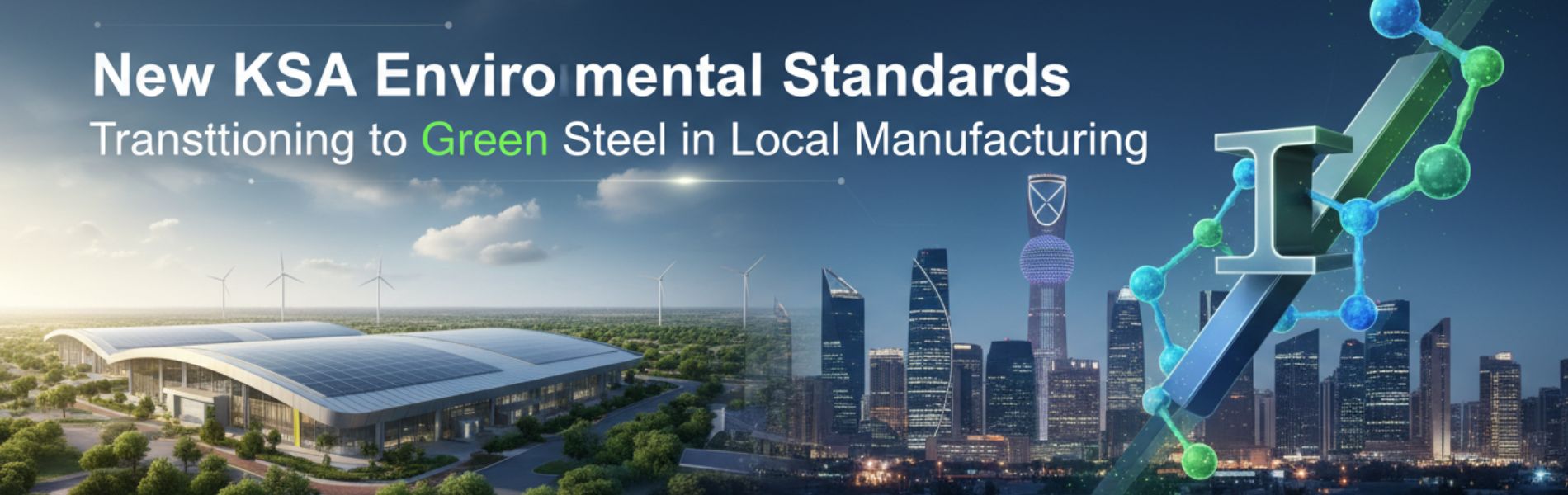
Saudi Arabia is uniquely positioned to thrive in the post-CBAM world. Under Vision 2030, the Kingdom is aggressively diversifying its economy and investing in sustainability. Unlike competitors in regions dependent on coal, the Saudi steel sector relies heavily on natural gas-based DRI and EAF routes, which have a naturally lower carbon footprint than the global average for blast furnace production.
Furthermore, with the rise of the Circular Carbon Economy and massive investments in Green Hydrogen (such as the NEOM project), Saudi steel exporters have a clear pathway to producing near-zero emission steel. The EU CBAM transforms sustainability from a corporate social responsibility metric into a hard financial asset. Saudi exporters can leverage this by documenting their lower embedded emissions to maintain market share in Europe while high-carbon competitors are priced out.
Navigating Compliance: The Data Challenge
The immediate hurdle for the industry is data transparency. The enforcement era demands rigorous carbon accounting. Exporters must be able to calculate and verify:
- Direct Emissions (Scope 1): Emissions from the production processes, such as the combustion of fuel.
- Indirect Emissions (Scope 2): Emissions generated from the production of electricity used in the manufacturing process.
- Precursor Emissions: Emissions embedded in raw materials (like ferroalloys) used in the process.
Failure to provide verified data according to EU methodology will result in the application of default values, which are punitive and set at the average emission intensity of the worst-performing X% of EU installations. Therefore, robust digital monitoring systems and third-party verification are no longer optional—they are prerequisites for market access.
The Ripple Effect on Global Pricing
As the EU imposes these tariffs, we anticipate a bifurcation in the global steel market. There will be a “green premium” market for low-carbon steel destined for regulated zones like the EU, and a “brown discount” market for high-carbon steel dumped into unregulated regions. However, as other nations (including the UK, Canada, and potentially the USA) consider similar carbon border taxes, the market for dirty steel will shrink rapidly.
Construction companies and automotive manufacturers within the EU are already securing supply contracts with low-carbon producers to ensure price stability post-2026. This creates a first-mover advantage for manufacturers who adapt now.
Conclusion: Embracing the New Industrial Reality
The enforcement of the EU CBAM is not merely a bureaucratic hurdle; it is a fundamental restructuring of international trade economics. The days of gaining market share solely through rock-bottom production costs at the expense of the environment are over. For SaudiSteelWork and the broader Saudi industrial sector, this is a validation of the shift toward high-tech, low-carbon manufacturing. By embracing sustainable metallurgy and rigorous carbon reporting, the industry can turn the CBAM challenge into a definitive competitive advantage, securing a leading role in the future of the global steel trade.