








EU Carbon Border Adjustment Mechanism (CBAM) Enforcement Reshapes Global Steel Trade
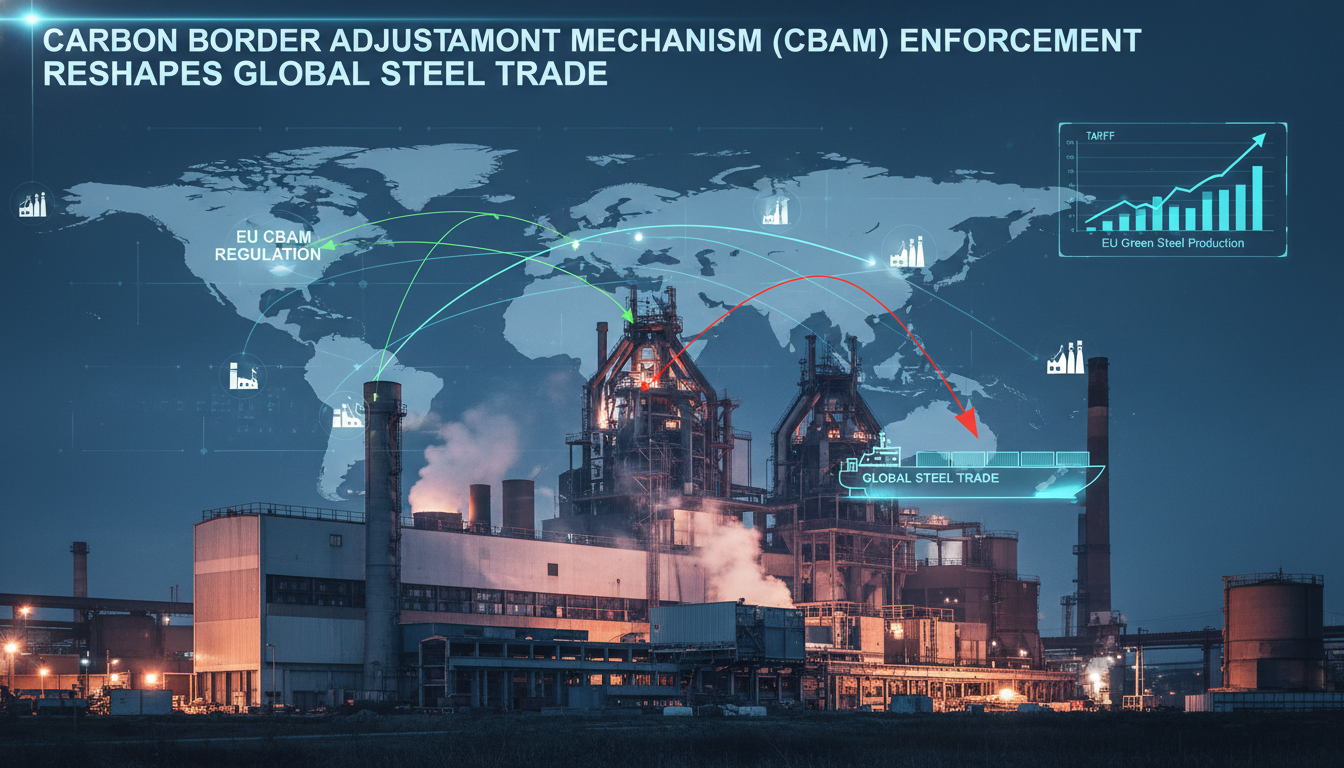
The global industrial landscape is undergoing a tectonic shift, driven by the urgent need for climate action. At the epicenter of this transformation lies the European Union’s EU Carbon Border Adjustment Mechanism (CBAM). As of October 2023, the transitional phase of this landmark regulation has commenced, signaling the end of the era where carbon emissions could be externalized without financial consequence. For the Global Steel Trade, this represents not just a regulatory hurdle, but a fundamental rewriting of market dynamics.
For stakeholders in the Middle East, particularly within the Saudi Steel Industry, understanding the nuances of CBAM is no longer optional—it is a strategic imperative. As the EU moves to penalize high-carbon imports, the competitive advantage will decisively shift toward manufacturers capable of proving low Embedded Emissions in their products.
Understanding the Mechanics of CBAM
The CBAM is essentially a climate measure designed to prevent Carbon Leakage. Carbon leakage occurs when companies based in the EU move carbon-intensive production abroad to countries with less stringent climate policies, or when EU products are replaced by more carbon-intensive imports. The mechanism ensures that the carbon price of imports is equivalent to the carbon price of domestic production under the EU Emissions Trading System (ETS).
Currently, we are in the transitional phase, which runs until the end of 2025. During this period, importers of goods in the scope of the regulation—including iron, steel, aluminum, cement, fertilizer, and hydrogen—must report the greenhouse gas emissions (GHG) embedded in their imports (direct and indirect emissions) without paying any financial adjustment. However, starting in 2026, the financial obligations kick in, requiring importers to purchase CBAM certificates corresponding to the carbon price.
The Scope of Reporting for Steel
For the steel sector, the reporting requirements are rigorous. Manufacturers must account for:
- Scope 1 Emissions: Direct emissions from the production process (e.g., combustion of fuels).
- Scope 2 Emissions: Indirect emissions from the generation of purchased electricity used in production.
- Scope 3 Emissions: Certain upstream emissions involved in the production of precursor materials.
This level of transparency requires a robust data infrastructure. Steel Manufacturers must now audit their supply chains with the same rigor they apply to their financial ledgers.
Economic Implications for Global Exporters
The enforcement of CBAM reshapes the cost structure of international trade. Traditionally, steel competitiveness was driven largely by labor costs, raw material availability, and logistics. Now, the Carbon Intensity of production is a primary cost driver. Countries relying heavily on coal-based Blast Furnace-Basic Oxygen Furnace (BF-BOF) routes will face significant tariffs when exporting to the EU.
This creates a distinct divergence in the market. Manufacturers in regions with high carbon footprints may see their margins erode or be forced to divert exports to non-EU markets, potentially saturating those markets and driving down prices globally. Conversely, producers utilizing Electric Arc Furnace (EAF) technology and Direct Reduced Iron (DRI) fueled by natural gas or hydrogen will gain a premium status in the European market.
The Competitive Landscape Shift
Major steel-exporting nations like China, India, and Turkey are scrambling to adapt. The EU is a critical market for these players, and the impending levies could amount to billions of dollars annually. This pressure is accelerating the global race toward Decarbonization. We are witnessing a surge in investments in Green Steel technologies, carbon capture utilization and storage (CCUS), and renewable energy integration into industrial grids.
The Saudi Advantage in a Low-Carbon Future
While CBAM poses a threat to traditional high-carbon producers, it presents a unique opportunity for the Saudi Steel Industry. Saudi Arabia is structurally advantaged to thrive in a CBAM-regulated world for several reasons.
First, the Kingdom’s steel production is already less carbon-intensive than the global average. A significant portion of Saudi production utilizes the DRI-EAF route, which generates significantly lower CO2 emissions compared to the coal-dependent blast furnaces dominant in parts of Asia. As the Global Steel Trade pivots toward sustainability, this existing infrastructure provides a head start.
Second, Saudi Arabia’s massive investments in renewable energy and Green Hydrogen—epitomized by projects like NEOM—position the nation to produce some of the world’s lowest-carbon steel. By transitioning DRI plants from natural gas to hydrogen, Saudi manufacturers can achieve near-zero emissions, effectively bypassing CBAM levies and securing duty-free access to the lucrative European market.
Strategic Imperatives for SaudiSteelWork
To capitalize on this shift, local entities must focus on three core areas:
- Data Granularity and Verification: Establishing systems to accurately measure and verify Embedded Emissions in compliance with EU methodologies is critical. Third-party verification will become the new standard for export documentation.
- Accelerating the Hydrogen Transition: Leveraging the Kingdom’s renewable energy goals to integrate green hydrogen into the steel reduction process will future-proof the industry against rising carbon taxes globally.
- Supply Chain Transparency: Ensuring that upstream suppliers also adhere to low-carbon practices, as Scope 3 emissions become part of the calculation.
The Road to 2026 and Beyond
The enforcement of CBAM is not an isolated event; it is the first domino in a global trend toward carbon pricing. Other jurisdictions, including the UK, Canada, and potentially the US, are considering similar border adjustment mechanisms. The EU Carbon Border Adjustment Mechanism has effectively set a global standard.
For the steel industry, the message is clear: Decarbonization is no longer just an environmental goal—it is a license to operate in the premium segments of the global economy. Manufacturers who view CBAM solely as a compliance burden risk obsolescence. Those who view it as a catalyst for innovation and a roadmap for Green Steel transition will define the future of the industry.
As we move through the transitional phase, SaudiSteelWork remains committed to analyzing these regulatory changes, optimizing our processes, and ensuring that the regional industry remains resilient, competitive, and sustainable in the face of evolving global trade norms.