



The global industrial landscape is standing on the precipice of a seismic shift, one that promises to redefine the very backbone of modern infrastructure. For decades, steel has been the unyielding skeleton of our cities, our transport networks, and our industries. However, the traditional methods of forging this essential material have come at a heavy environmental price. Today, as the Kingdom of Saudi Arabia accelerates toward the ambitious goals of Vision 2030, the nation is not merely adapting to global trends; it is positioning itself to lead them. The transition to Green Steel via Hydrogen Direct Reduced Iron (DRI) represents more than just a technological upgrade—it is a strategic imperative for the future of Saudi Steel Work and the Kingdom’s economic diversification. This is the dawn of a new industrial era, where heavy industry meets radical sustainability.
For stakeholders in the Saudi construction and manufacturing sectors, the writing is on the wall. The global demand for low-carbon materials is skyrocketing, driven by regulatory frameworks like the European Union’s Carbon Border Adjustment Mechanism (CBAM) and corporate ESG commitments. Saudi Arabia, with its abundant renewable energy resources, stands uniquely positioned to dominate this new market. But to understand the magnitude of this opportunity, we must first dissect the mechanism of change: the shift from carbon-intensive blast furnaces to the clean power of Hydrogen DRI. This comprehensive guide explores why this transition is inevitable, how it works, and what it means for the Saudi market.
1. The Carbon Conundrum: Why Traditional Steelmaking Must Evolve
To appreciate the solution, one must understand the problem. Traditional steel production, primarily via the Blast Furnace-Basic Oxygen Furnace (BF-BOF) route, is one of the most carbon-intensive industrial processes on the planet. It relies heavily on coking coal as both a fuel and a reducing agent to strip oxygen from iron ore. This chemical reaction releases massive amounts of carbon dioxide—approximately 1.85 tons of CO2 for every ton of steel produced. For a nation like Saudi Arabia, which is currently undergoing an unprecedented construction boom fueled by giga-projects like NEOM, the Red Sea Project, and Qiddiya, continuing down this path poses a conflict with the Kingdom’s net-zero aspirations.
The pressure is not just environmental; it is economic. International markets are increasingly penalizing high-carbon products. If Saudi Steel Work is to remain competitive on a global scale, specifically in export markets targeting Europe and North America, decarbonization is no longer optional. It is a license to operate. The legacy infrastructure of coal-dependent steelmaking is rapidly becoming a stranded asset risk. The industry needs a solution that maintains the high quality and volume of steel output required for skyscrapers and infrastructure while severing the link between production and pollution. This is where the Direct Reduced Iron (DRI) pathway becomes the protagonist of our story.
2. The Science of Salvation: Unpacking Hydrogen DRI Technology
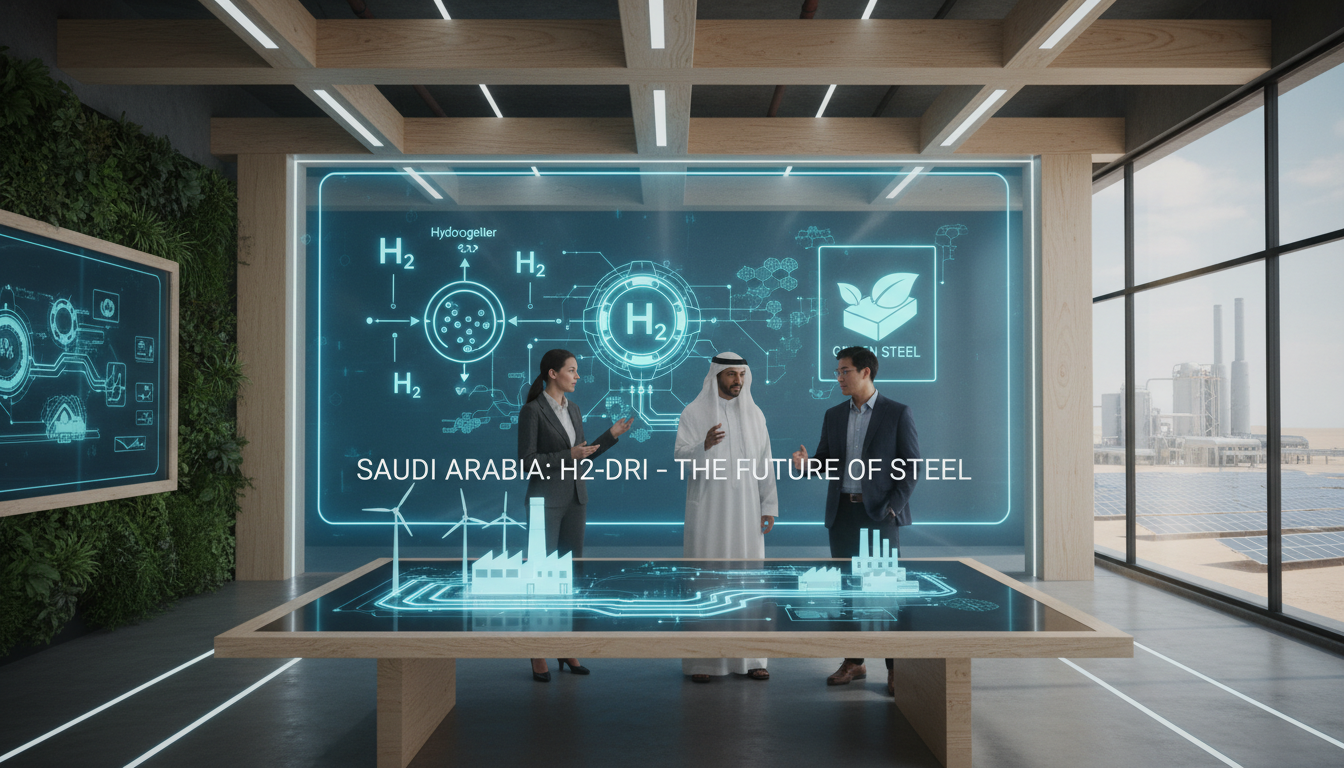
Direct Reduced Iron (DRI) technology is not entirely new; however, the fuel source driving it is undergoing a revolutionary change. Traditionally, DRI plants use natural gas (methane) to produce a reducing gas mixture of hydrogen and carbon monoxide. While this is cleaner than coal, it still emits CO2. The game-changer is the substitution of natural gas with green hydrogen. In a Hydrogen DRI (H2-DRI) process, hydrogen gas is produced via electrolysis powered by renewable energy. When this green hydrogen is introduced to the shaft furnace containing iron ore pellets, a miraculous chemical substitution occurs.
Instead of carbon atoms bonding with the oxygen in the iron ore to form CO2, hydrogen atoms bond with the oxygen to form H2O—pure water vapor. The byproduct of this industrial process is no longer a greenhouse gas; it is water. The resulting sponge iron is then fed into an Electric Arc Furnace (EAF), powered by renewable electricity, to be melted down into high-quality steel. This route, often referred to as the H2-DRI-EAF pathway, has the potential to reduce carbon emissions by over 95%. For Saudi Steel Work, adopting this technology means producing distinctively ‘Green Steel’—a premium product that commands higher value in a climate-conscious global economy.
3. The Kingdom’s Edge: Saudi Arabia as a Green Hydrogen Superpower
Why is Saudi Arabia poised to become the global capital of Green Steel? The answer lies in geography and geology. The production of green hydrogen requires vast amounts of renewable electricity to power electrolyzers. Saudi Arabia possesses some of the highest solar irradiance levels in the world and favorable wind corridors, allowing for the generation of renewable energy at record-low Levelized Costs of Electricity (LCOE). While European steelmakers struggle with high energy costs and intermittent renewables, Saudi Arabia can produce the necessary green hydrogen at a fraction of the cost, creating a virtually insurmountable competitive moat.
We are already seeing the seeds of this dominance. The NEOM Green Hydrogen Company is set to be the world’s largest utility-scale, commercially-based hydrogen facility. This availability of low-cost green hydrogen creates a synergistic ecosystem for heavy industry. By localizing the value chain—from iron ore processing to hydrogen generation and steel fabrication—Saudi Arabia can transition from being an exporter of crude oil to an exporter of decarbonized industrial goods. For local fabricators and engineering firms involved in Saudi Steel Work, this translates to supply chain security and immunity from volatile global fossil fuel prices.
4. Economic Implications: Future-Proofing the Saudi Steel Sector
The transition to Hydrogen DRI is not merely an environmental crusade; it is a robust economic strategy aligned with Vision 2030’s pillar of a thriving economy. By pioneering green steel, Saudi Arabia fosters high-tech job creation in engineering, metallurgy, and renewable energy management. Furthermore, it protects the local industry from future carbon taxes that could cripple traditional manufacturers. As global automakers and construction giants pledge to source 100% net-zero steel by 2040 or 2050, early adopters in the Saudi market will become the preferred suppliers for international partnerships.
Consider the domestic demand. The giga-projects transforming the Kingdom require millions of tons of steel. Using green steel for these projects serves a dual purpose: it lowers the embodied carbon of the Kingdom’s flagship developments, enhancing their sustainability credentials, and it stimulates the local green economy. We are moving toward a future where ‘Made in Saudi Arabia’ steel is synonymous with the highest environmental standards. For businesses in the sector, failing to adapt to the DRI transition risks obsolescence, while embracing it opens doors to premium markets and government incentives designed to accelerate industrial decarbonization.
5. The Path Forward: Scaling Up and Overcoming Challenges
Despite the immense potential, the road to full-scale Hydrogen DRI adoption is paved with challenges that require strategic navigation. The primary hurdle is the scaling of electrolyzer capacity and the establishment of hydrogen transport infrastructure. While the cost of renewables is low, the initial CAPEX for H2-DRI plants is significant. It requires a collaborative effort between the public sector, represented by entities like the Public Investment Fund (PIF), and private industrial leaders. We must also address the technical requirements of retrofitting existing DRI plants that currently run on natural gas to handle 100% hydrogen, a process that requires metallurgical expertise and precise thermal management.
However, the trajectory is clear. The government’s commitment to producing 4 million tons of clean hydrogen annually by 2030 provides the roadmap. The steel industry must now align its investment cycles with this national hydrogen strategy. For Saudi Steel Work, this means investing in R&D, upskilling the workforce to handle new technologies, and forming strategic alliances with renewable energy providers. The transition will be phased—likely starting with a blend of natural gas and hydrogen, and gradually moving to 100% hydrogen as supply stabilizes. The companies that begin this integration today will define the market standards of tomorrow.
Conclusion: The Time to Forge the Future is Now
The transition to Green Steel via Hydrogen DRI is the single most significant disruption in the history of metallurgy since the industrial revolution. For Saudi Arabia, it represents a golden opportunity to leverage natural advantages to become a global heavyweight in sustainable heavy industry. The convergence of Vision 2030, abundant solar and wind energy, and a booming construction sector creates the perfect storm for innovation. We are no longer just building structures; we are building a legacy of stewardship and economic resilience.
For leaders, investors, and engineers in the Saudi Steel Work ecosystem, the call to action is urgent. The era of carbon-heavy steel is setting; the era of Green Steel is rising from the desert sands, powered by the sun and the wind. Do not be left behind in the old economy. Embrace the hydrogen revolution, invest in sustainable technologies, and let us forge a future that is as strong as steel and as clean as the air we aspire to breathe. Join the movement toward a decarbonized Kingdom today.